Simple vs. Compound Interest: Formulas, Examples, and Differences
Simple interest is calculated on the original principal, while compound interest is calculated on the principal plus interest already accumulated. With the same starting amount and a positive rate, reinvesting interest allows a compound balance to pull further ahead over time. When comparing real products, you also need to account for deposit dates, taxes, fees and withdrawal conditions.
What is the difference between simple and compound interest?
Your principal is the money you initially deposit. Interest is the money earned on it, and the total balance includes both principal and interest. The distinction between simple and compound interest is the amount used as the base for the next interest calculation.
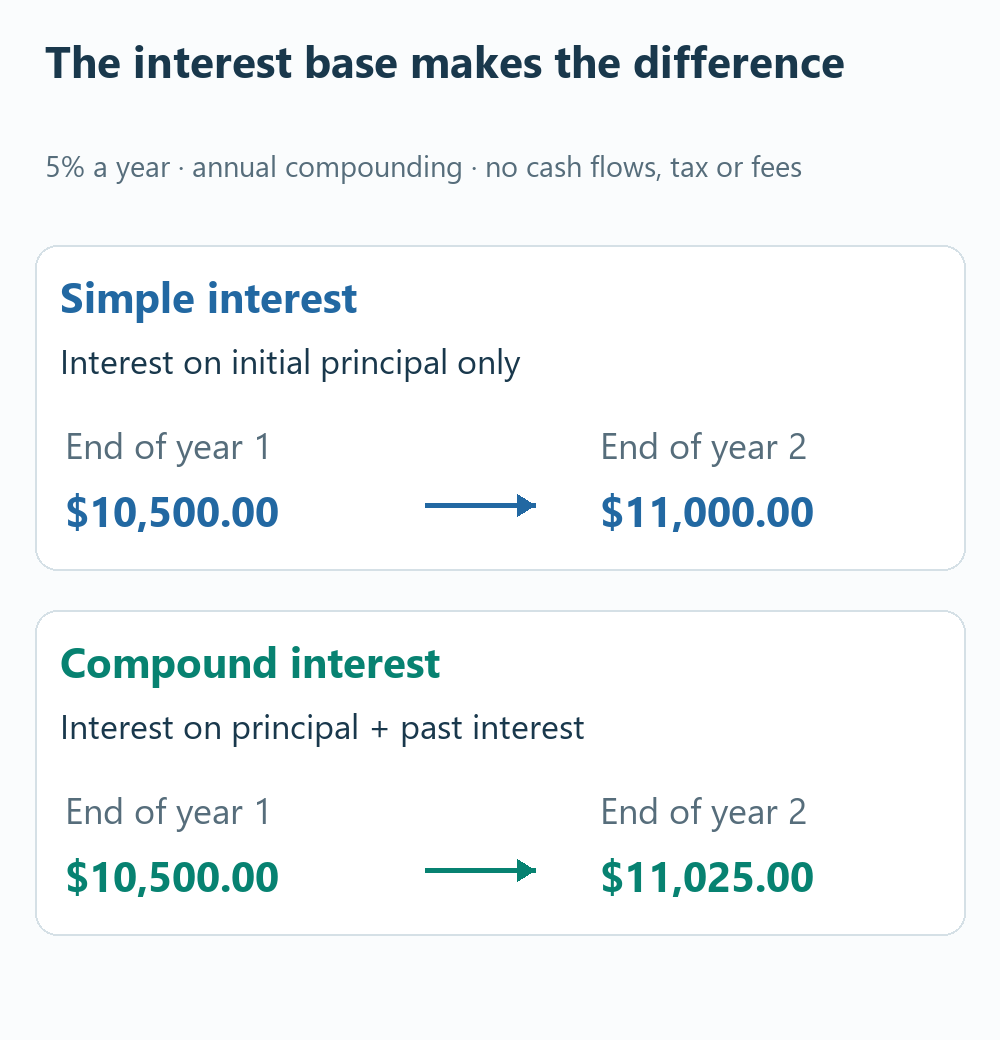
Suppose you deposit $10,000 at 5% a year. Under simple interest, the original $10,000 remains the interest base. With an unchanged principal and rate, you earn $500 each year. Previously earned interest does not generate further interest within that calculation.
With annual compounding, the first year's $500 is added to the balance. In the second year, 5% is applied to $10,500, producing $525 of interest. The additional $25 comes from earning interest on the first year's interest. The U.S. Securities and Exchange Commission's Investor.gov definition of compound interest describes this combination of interest on principal and accumulated interest.
How do you calculate simple and compound interest?
The following examples assume one initial deposit, a fixed rate, no further deposits or withdrawals, and no taxes or fees. The 5% rate is a hypothetical teaching assumption, not a current product offer. Calculations retain their precision until the displayed dollar amounts are rounded to cents.
- P is the initial principal.
- r is the annual interest rate expressed as a decimal: 5% becomes 0.05.
- t is the time in years.
- A is the ending balance, including principal.
Simple interest formula and example
Simple interest = P × r × t
Ending balance A = P × (1 + r × t)
For $10,000 at 5% simple interest over three years, interest is 10,000 × 0.05 × 3 = $1,500. Adding the original $10,000 gives an ending balance of $11,500. Keeping interest and total balance separate prevents you from mistakenly counting your original money as a gain.
Compound interest formula and example
Balance with annual compounding A = P × (1 + r)t
Compound interest earned = A − P
At the same rate, $10,000 compounded annually for three years becomes 10,000 × 1.053 = $11,576.25. The interest earned is $1,576.25, which is $76.25 more than the simple-interest example. On a basic calculator, multiply $10,000 by 1.05 three times to reproduce the result.
The rate and time units must agree. Do not enter a 5% annual rate as a 5% monthly rate or use a number of months as t in this annual formula. The underlying calculation methods are also explained in the Federal Reserve's lesson on simple and compound interest.
How much difference does compounding make over time?
This comparison starts with $10,000 and holds the annual rate at 5%, with annual compounding in the compound column. Simple interest adds the same amount each year; compounding increases the base on which interest is earned. Every amount in the table is a total balance, including the original principal.
| Years | Simple balance | Compound balance | Compound advantage |
|---|---|---|---|
| 1 | $10,500.00 | $10,500.00 | $0.00 |
| 3 | $11,500.00 | $11,576.25 | $76.25 |
| 5 | $12,500.00 | $12,762.82 | $262.82 |
| 10 | $15,000.00 | $16,288.95 | $1,288.95 |
| 20 | $20,000.00 | $26,532.98 | $6,532.98 |
After one year, both balances are $10,500. With annual compounding, the first year's interest only starts producing additional interest in the following year. After ten years, the balances are $15,000 with simple interest and about $16,288.95 with compounding. At twenty years, they are $20,000 and about $26,532.98.
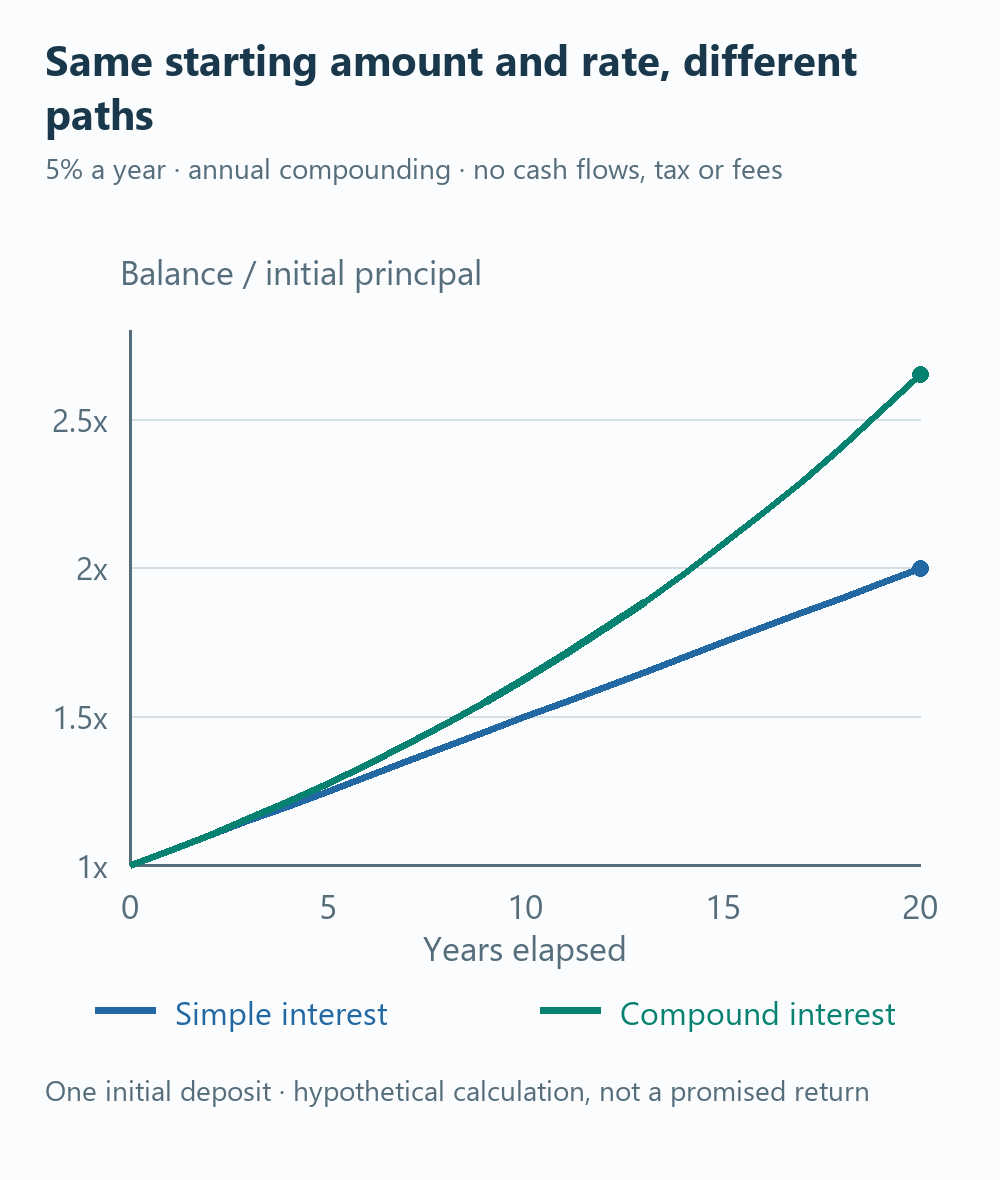
The graph expresses the balance as a multiple of the initial principal. The simple-interest path rises by an equal amount each year. The compound path becomes steeper as accumulated interest increases. These are calculations at a constant assumed rate, not a prediction that an investment will earn 5% every year.
What makes the effect of compounding larger?
At an unchanged positive rate, a longer holding period gives reinvested interest more opportunities to generate further interest. Doubling the principal doubles the dollar interest and the dollar gap between the two methods under identical conditions; it does not double the percentage return.
The rate and compounding frequency matter too. The U.S. Consumer Financial Protection Bureau's explanation of compound interest highlights how changing these inputs changes a balance. Before comparing frequencies, establish what the quoted annual rate actually represents.
If a 5% nominal annual rate is divided by 12 and compounded monthly, the formula is A = P × (1 + 0.05 ÷ 12)12t. The effective increase over one year is approximately 5.1162%, slightly above 5% with annual compounding. However, if two products already have the same effective annual yield, a shorter compounding interval does not by itself create a higher annual return.
For U.S. deposit accounts, APY means annual percentage yield and incorporates the effect of compounding. The CFPB's APY calculation rules explain that basis. A figure labeled “annual interest rate” in another country should not automatically be treated as an equivalent measure.
Interest that you withdraw and spend, or leave elsewhere without earning a return, cannot continue compounding in the original account. Investment returns can also be negative. Reinvestment describes a mechanism; it does not guarantee a positive result or eliminate the risk of loss.
What should you check when comparing a lump-sum deposit with monthly saving?
A lump-sum deposit and a monthly saving plan differ in when money enters the account. Simple and compound interest describe how interest is calculated. These are separate distinctions: a lump-sum product is not automatically compound, and a monthly contribution plan is not automatically simple. Read the particular product's interest and payment terms.
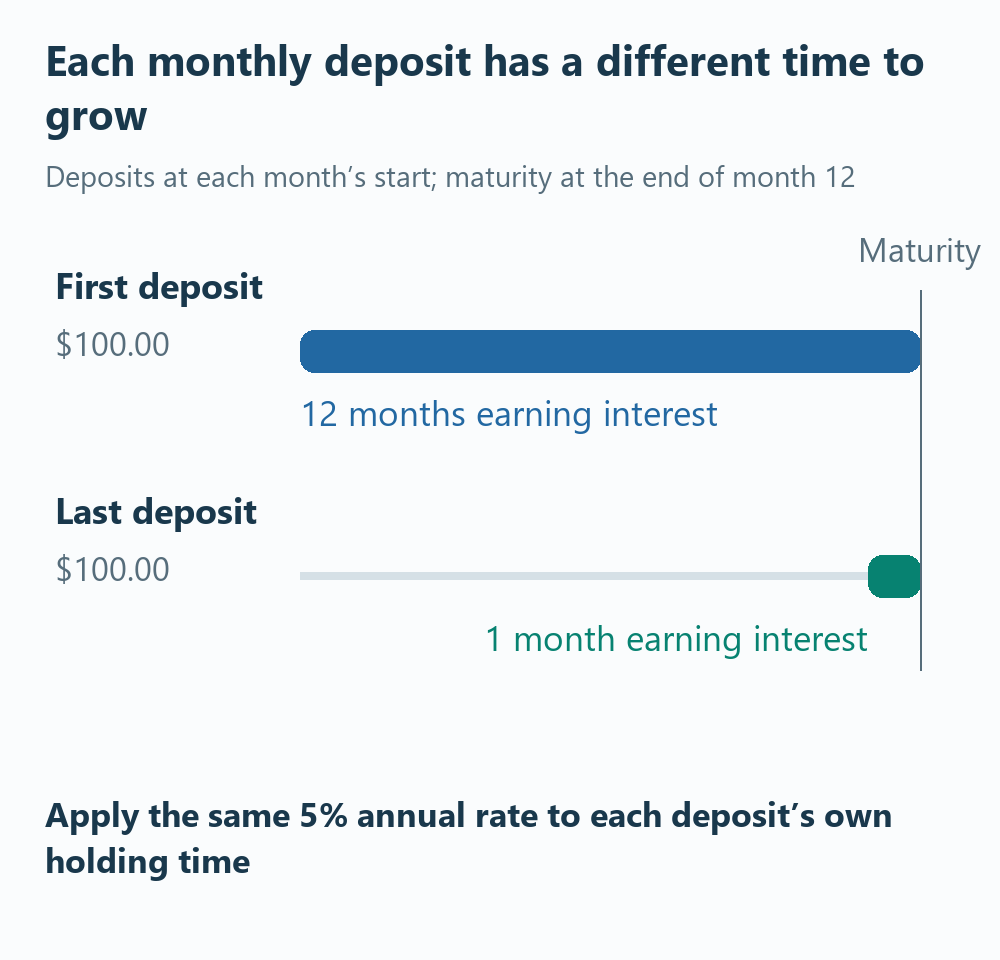
Monthly contributions also have different holding periods. Suppose you deposit $100 at the start of each month for twelve months, with a common maturity date at the end of month twelve. The first contribution earns interest for twelve months, while the last earns it for only one month. In a simplified monthly model at 5% simple annual interest:
100 × 0.05 × (12 + 11 + … + 1) ÷ 12 = $32.50
You contribute $1,200 in total, but the entire $1,200 is not invested from the start. That explains the difference from the $60 of simple interest earned by depositing $1,200 for a full year. The two cash-flow schedules are different, so this is not a like-for-like comparison of returns, nor does it mean the monthly plan pays half its stated rate. Actual amounts can vary with deposit dates, maturity dates and day-count rules.
When comparing actual products, check these conditions together:
- Deposit amounts and dates: distinguish money you already have from money you will save out of future income.
- The rate and its conditions: identify a nominal rate versus an effective yield, fixed versus variable rates, and any requirements for a promotional rate.
- Taxes and fees: compare the amount you actually keep after applicable deductions. Tax treatment depends on the country, account and your circumstances.
- Interest payment and early withdrawal: establish whether interest is reinvested automatically and how taking money out early changes the rate or charges.
Locking money away also means giving up its use elsewhere. Thinking about opportunity cost and how to evaluate it helps make that trade-off explicit. For money you may need soon, such as an emergency reserve, access to the funds matters alongside the interest rate.
Is a compound-interest product always the better choice?
With the same principal, positive rate, holding period and cash flows, reinvesting interest can give compounding an advantage. Different products do not necessarily offer the same rate, however. Over one year, 5.2% simple interest produces more than a 5% nominal annual rate compounded monthly, whose effective yield is about 5.1162%. Both figures here exclude taxes and fees.
For borrowed money, interest on interest can increase your burden. If unpaid interest is added to principal, later interest is calculated on a larger base. The CFPB discusses this capitalization mechanism in its student-loan interest explanation. Not every loan uses the same rules, so consult the actual interest, repayment and late-payment terms rather than assuming every debt compounds in the same way.
Before choosing a product, write down how much you will put in, when you will put it in, and when and how much you can take out. Compare after-tax proceeds, access conditions and risk on the same cash-flow schedule and time horizon. That is more useful than choosing on the word “compound” alone.